Transcript
Announcer:
You’re listening to Clinician’s Roundtable on ReachMD, and this episode is sponsored by Blueprint Medicines, a Sanofi company. Here’s your host, Dr. Charles Turck.
Dr. Turck:
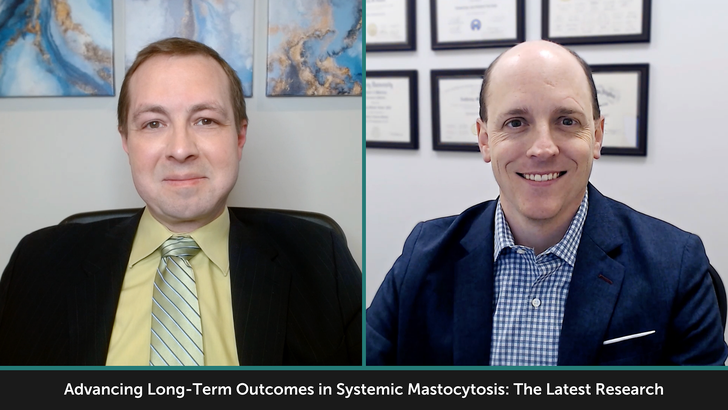
Welcome to Clinician's Roundtable on ReachMD. I'm Dr. Charles Turck, and joining me to explore the latest advances in systemic mastocytosis research is Dr. Anthony Hunter. Not only is he an Associate Professor in the Department of Hematology and Medical Oncology at the Emory University School of Medicine, but he also serves as the Medical Director of the Immediate Care Center and leads the Myeloproliferative Neoplasm Program at the Emory Winship Cancer Institute in Atlanta. Dr. Hunter, thanks for being here today.
Dr. Hunter:
Absolutely. Thank you so much for having me.
Dr. Turck:
Well, to begin, recent discussions at major meetings like the American Society of Hematology and the American Academy of Allergy, Asthma, and Immunology have highlighted a shift from focusing on initial response to understanding durability and long-term disease control in systemic mastocytosis. From your perspective, Dr. Hunter, what's driving that evolution, and how is it changing the way we think about treatment success and advanced disease?
Dr. Hunter:
Yeah, absolutely. I think we've seen some great data in the last year or two from some of the longer-term follow-up from these studies. And I think really what's driving this change in how we're thinking about success is our success, right? I think based on the high level of responses that we're seeing, we're moving to that next step—not just are we seeing responses early on, but are they sustained? Are we seeing these long term, and how are they impacting long-term outcomes? And I think this is a great movement for the field.
I think for a long time, systemic mastocytosis was a bit of an orphan disease, if you will. There wasn't a lot of therapies for this. Doctors didn't necessarily want to see it. They didn't know what to do with these patients. And so times are changing, I think, which is great for our patients with mastocytosis, and we're seeing high levels of success early on with some of our newer drugs like avapritinib and our KIT inhibitor therapies.
And so the success that we're seeing is now breeding hopefully longer-term success of longer-term responses and better long-term outcomes like survival and disease progression. These are really becoming more of the focus at this point—not just what do blood counts and initial organ function look like, but what do they look like 2, 3, or 4 years down the road? And how are these responses being maintained in patients?
Dr. Turck:
Now you were just starting to touch on this, but as you were mentioning, we're starting to see longer-term follow-up data from studies of KIT-directed therapies, particularly in advanced subtypes like ASM and SM-AHN, showing that some patients can maintain hematologic and organ responses over extended periods and can even continue to improve beyond initial response milestones. So how do you interpret these longer-term response patterns in the context of what we've historically seen in this disease?
Dr. Hunter:
It's been fantastic to see some of this longer-term response data now, and we've seen this presented at ASH at the end of 2025 and actually data has now been published from the long-term follow-up from the PATHFINDER study. And so what we're seeing is responses early on. For time to response, often it's within the first month and a half to two months that we're seeing responses, but they're deepening over time, especially for folks who are reaching complete remission. We're often not seeing that; the average was about nine months in that study, and even for patients who had prior therapies, it was over a year.
And so we're seeing relatively early responses, but then we're seeing continued deepening of response over time, which is fantastic. And we see some impact on dose in regard to that as well as disease subtype and those sorts of things. But certainly, we're seeing these long-term responses, which is fantastic. And so this is true for blood count improvements. We're seeing this in regard to what we call C-findings, right? Our organ dysfunction or other measures of disease manifestation that we see in mastocytosis. And we're seeing long-term improvement in these. And I think what we're seeing in this long-term data here is we're seeing long-term durability of response. The median duration of response is now five-plus years. And so we're seeing really significant improvement, I think, in what we would've historically seen in this disease, especially in this particular subgroup of more advanced patients.
And that does vary a little bit from disease subtype. We see, for example, the true aggressive mastocytosis patients—pure ASM as we call it, without an associated hematologic neoplasm—and those patients are having really high-level maintenance of response, very few disease progression, and really fantastic survival long term. And where we're seeing the alternative to that a little bit is—we still see great success—we are seeing more disease progression and probably a little bit more loss of response and not quite the same level of survival in what we call SM-AHN, or mastocytosis with an associated hematologic neoplasm. Most commonly, that's been chronic myelomonocytic leukemia. And so we do see those patients; they're a really tough group of patients to know how to treat them in the first place. And we are seeing not quite the same level of success in those patients, but certainly still significantly better than what we've historically had in that particular patient group.
Dr. Turck:
Now alongside efficacy, we're also seeing an evolution in longer-term safety data. While cytopenias, off-target effects, and cumulative toxicity are still relevant concerns, extended follow-up has shown that dose adjustments can help mitigate these risks. But what does a dynamic approach to dosing and long-term safety look like in practice?
Dr. Hunter:
I think what we see with the longer-term data, especially in the aggressive SM population—and in all honesty, in my clinical practice as well—is we tend to see a lot of these adverse effects relatively early on. So we'll see a lot of adjustment. The disease is more active at that point. It's a new therapy. And then things tend to decrease a little bit over time. We don't see a lot of cumulative toxicity. And part of that is maintained through dose reductions. What we've seen with avapritinib, for example, is even in the phase one study, you see responses even at low doses.
And so I think what that gives us a little bit more comfort with is especially for patients who are already responding or who have significant toxicity where we still want to try to keep them on the drug, dose reductions can be a really effective way to help keep people on therapy to better balance that ratio of efficacy and toxicity. And we see in the long-term advanced SM population in that PATHFINDER study that about three-quarters of patients long-term are ending up on lower doses. So really, the majority of patients, even in a clinical trial where things are a little bit more rigid, are seeing dose reductions.
And certainly that's true in my practice as well. I think the large number of my advanced SM population are ending up on lower doses. And if there's a patient I'm concerned about, I'll occasionally start them at a little bit lower dose as well just to take a more proactive approach to that. And so I think dose reductions are a mainstay in therapy at this point. They should be considered, especially for patients who are seeing some toxicity. And thankfully, we really don't see much of a drop-off in long-term efficacy, which is fantastic and is helping to balance that approach.
Dr. Turck:
For those just tuning in, this is Clinician's Roundtable on ReachMD. I'm Dr. Charles Turck, and I'm speaking with Dr. Anthony Hunter about the latest developments and evolving long-term data around research in systemic mastocytosis.
Now, Dr. Hunter, we're also seeing important insights in indolent systemic mastocytosis, where newer data go beyond symptom control to show sustained improvements in quality of life and reductions in events like anaphylaxis. How might these findings change the way we define meaningful benefit in these patients?
Dr. Hunter:
Benefit's always been a lot more subjective, so to speak, right? Indolent SM is different than aggressive SM, and so we're measuring objective things like blood counts, organ function, and things like that. We're truly just looking at symptoms here in indolent patients.
And so to get around that and to try to make that more objective, most of these clinical trials have used some form of a symptom measure or some sort of patient-reported outcome measure—a symptom survey, if you will—to more objectively monitor that data. And this has been a little bit different across different drugs in clinical trials that we've seen with avapritinib versus some of the newer drugs like bezuclastinib, for example. But nonetheless, it has been a very similar approach.
Most of these indolent studies have looked at relatively early time points initially—about 24 weeks compared to placebo—to see improvements in these symptom measures. And those really highlight some of the key symptoms that we see in this indolent SM population. And so what we've seen is that these drugs are very effective in controlling symptoms, and we're seeing—much like the advanced population—deepening of that symptom response over time. So even if you look at, for example, 96 versus 48 weeks or 48 versus 24 weeks, we're seeing deepening of the response that we're seeing with symptoms.
And these symptom measures have been a good way to measure this. But they also are somewhat focused on very disease-specific symptoms. And we've certainly incorporated other quality-of-life metrics, which maybe get a little bit beyond just the direct disease-related symptoms to be a little bit more broad measure of quality of life. Because certainly, we could improve disease symptoms while adding toxicity or adding other impacts on quality of life. And so these more broad measures help to really account for that and to get a broad look at patients and truly know: How are they functioning? How are they feeling? How is it impacting their life on a day-to-day basis?
And this is how I think about it in my clinical practice. Certainly, we use these more in-depth symptom measures and questionnaires quite a bit in clinical trials. And they have a role in the clinic as well. But I tend to use more broad questions like: How are you feeling? How are you doing compared to this? Can you do this when you couldn't before? These broad questions get at their function and how they're impacting their quality of life with this new therapy that we're doing, and we find that really successful most of the time.
Dr. Turck:
Another area that's evolving is our understanding of disease biology. We now recognize that advanced systemic mastocytosis is a multi-layered clonal disorder, where KIT D816V coexists with additional mutations that can influence prognosis and response. So where do you see these molecular insights having the greatest impact in clinical practice today?
Dr. Hunter:
So we're really starting to do a lot more of this genetic testing. I think this is more so true in the advanced SM population, but certainly, we do a little bit in the indolent SM group as well. But we're really pulling on some of our knowledge, I would say, from related myeloid disorders. We know, for example, that mastocytosis can occur with CMML, MDS, and other related diseases where this sort of genetic characterization of these diseases is key to our knowledge of these diseases. It changes the prognosis, treatment patterns, and things like that. And so we're really expanding that knowledge here, especially into the advanced SM population.
We know that there are several mutations—SRSF2, RUNX1, ASXL1, and possibly NRAS—that have been shown in various studies to impact survival in advanced SM populations, and they've really made their way into some of the prognostic or risk stratification scoring systems that we can use to help estimate prognosis for patients. And right now, in particular, that's where they have probably the biggest role; they can help us tailor the diagnosis and prognosis for a patient. We know some of these mutations can be shared between the associated hematologic neoplasm, but these mutations can help a little bit with refining that diagnosis and helping identify some of these associated myeloid disorders.
We hope as we continue to move forward that they'll expand a little bit more on how we treat patients. Certainly in other myeloid diseases, we have some mutation-directed therapies, if you will, outside of the KIT mutation, of course. And targeting KIT as we do in mastocytosis, we don't have a lot of those in mastocytosis or the mutations we commonly see here, but that's something that could evolve over time. We can hopefully even learn more about other certain molecular subgroups of patients that maybe don't respond as well to a certain drug but do better with one or that we know that we're going to have to do something a little bit differently upfront to have more success for those patients. And so there are more things to learn about how we can use these mutations to tailor therapy and tailor the treatment course for patients as we move forward.
Dr. Turck:
Now given everything we discussed today, Dr. Hunter, how do you see these advances in the growing body of long-term data shaping the future management of advanced systemic mastocytosis?
Dr. Hunter:
Yeah. I think what we're seeing is, most importantly, we have options now, right? Certainly in the past, we didn't have necessarily great drugs, especially tolerable ones to treat advanced SM, and I think this emergence of these more specific KIT-targeted therapies, including avapritinib, have really changed that approach for us.
And most importantly, we're a lot more successful at treating the disease than we used to be. The key thing is going to be these long-term outcomes. Obviously, we're seeing responses. We talked about the maintenance of these responses, and aggressive SM in the past has been a disease where survival's measured in a few years, oftentimes even less than that for mast cell leukemia. And we seem to be dramatically improving that, and we probably have not even truly defined yet what that really looks like now in the current era of hopefully having multiple of these KIT inhibitor drugs that'll be on the market in the future.
And so we're advancing outcomes. We're improving therapy quite a bit. It really requires us to be a lot more broad in how we capture response and success in patients. Obviously, we used mostly symptom-directed measures in indolent disease and advanced SM historically—these response metrics. But certainly, survival and disease progression are key. We're starting to see longer-term data from both indolent and aggressive SM where we're seeing reductions potentially in things like anaphylaxis in indolent disease and improvements in bone health, which can be a big factor in quality of life in patients. And so we have multiple ways to evaluate response impact on the disease overall. And it's really important that we're going to be evaluating all those things to see how patients are doing and see when the right time is to change therapy and things like that.
Dr. Turck:
Well, given those potential impacts, I want to thank my guest, Dr. Anthony Hunter, for joining me to discuss the latest insights in clinical data shaping care in systemic mastocytosis. Dr. Hunter, it was wonderful having you on the program.
Dr. Hunter:
Absolutely. Thank you so much for having me. It was a great discussion.
Announcer:
This episode of Clinician’s Roundtable was sponsored by Blueprint Medicines, a Sanofi company. To access this and other episodes in our series, visit Clinician’s Roundtable on ReachMD.com, where you can Be Part of the Knowledge. Thanks for listening!